
Growing a small business today is not only about having a good product or service. People are searching online before they decide where to buy, whom to contact, or which business to trust.
That is why having a strong online presence has become important for small businesses. With the right digital marketing approach, even a small business can reach the right customers, build credibility, and compete with larger brands.
What Is Digital Marketing for Small Businesses?
Digital marketing for small businesses is the process of using online platforms and digital channels to promote a business, connect with potential customers, and generate leads or sales.
It can include activities such as SEO, Google Ads, social media marketing, content marketing, email marketing, local SEO, and website optimization. A business does not necessarily need to use all of these channels. The right choice depends on its audience, goals, location, competition, and budget.
For example, a local restaurant may focus on Google Search, Google Business Profile, local SEO, and Instagram to attract nearby customers. An online store, on the other hand, may get better results from SEO, Google Ads, Meta Ads, and content marketing.
The purpose is not simply to get more website visitors or social media followers. Good digital marketing focuses on reaching people who are actually interested in what the business offers and guiding them towards an action, such as making an enquiry, placing an order, booking a service, or visiting a store.
For small businesses, this makes digital marketing a practical way to build visibility and reach potential customers without depending entirely on traditional advertising.
Why Is Digital Marketing Important for Small Businesses in 2026?
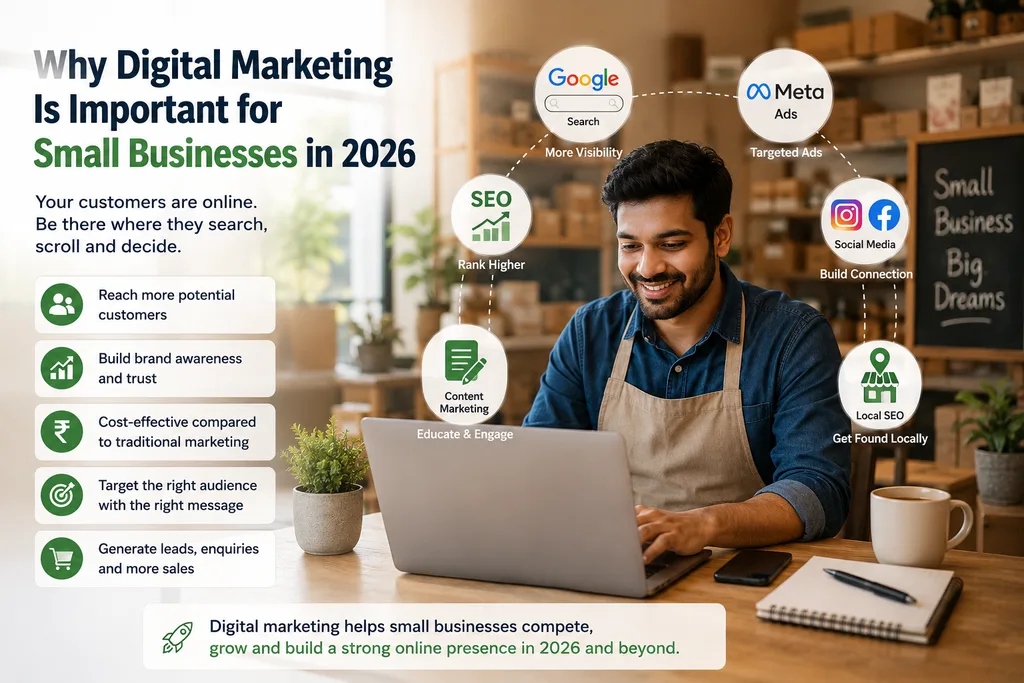
Imagine someone needs a service that your business provides. Instead of asking friends or walking around the market, they take out their phone and search for it online.
They may check the first few results on Google, look at reviews, visit a website, or check the business’s Instagram page before making a decision. If they cannot find your business, there is a good chance they will contact someone else.
This is one of the biggest reasons digital marketing for small businesses matters in 2026.
A strong online presence helps your business stay visible when potential customers are already looking for a product or service like yours. SEO can help people discover your website through search engines, while Google Ads can put your business in front of customers with immediate buying intent. Social media can help you build familiarity and trust before someone is ready to buy.
Digital marketing also gives small businesses something traditional advertising often struggles to provide: measurable results. You can see where your visitors are coming from, how many people are contacting you, which ads are generating leads, and where your marketing budget is being spent.
But there is another change businesses cannot ignore. People are no longer relying only on traditional Google searches. AI-powered search and conversational platforms are becoming another way to discover information, products, services, and businesses.
That means being online is no longer enough. Your business needs useful content, a trustworthy website, accurate business information, and a clear presence across the channels your customers use.
The good news is that small businesses do not need to do everything at once. The key is to understand your customers, choose the right digital channels, and build your marketing efforts step by step.
Which Digital Marketing Channels Should Small Businesses Use?
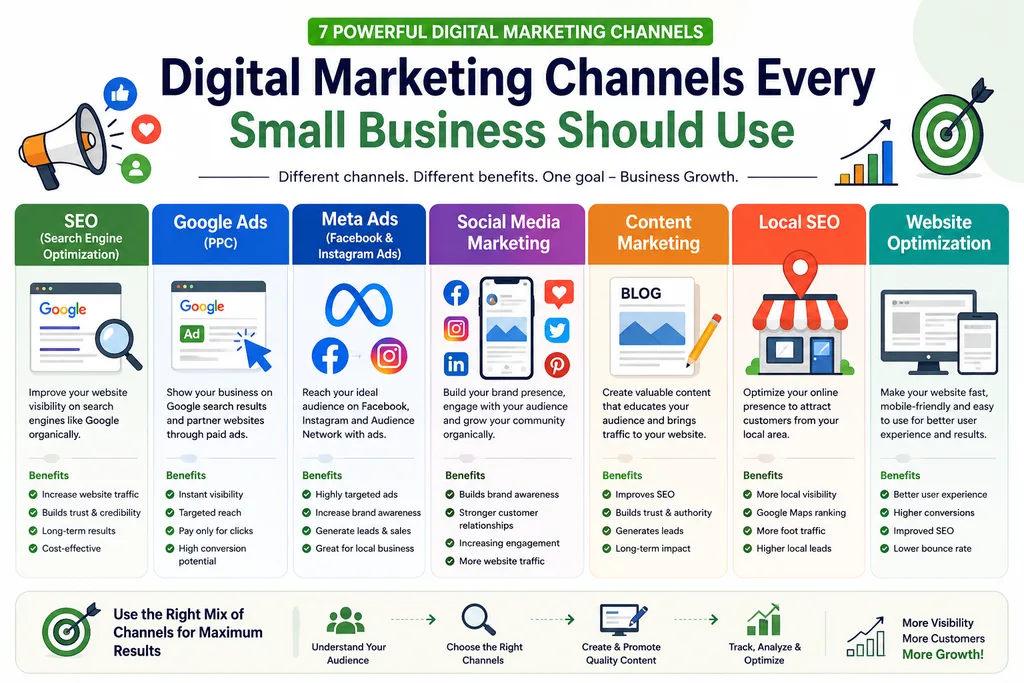
There is no single digital marketing channel that works for every small business. A local service provider, an e-commerce store, and a neighbourhood restaurant may all need different approaches.
The right strategy usually starts with understanding where your potential customers spend their time and how they search for businesses like yours.
Search Engine Optimization (SEO)
SEO helps your website appear in organic search results when people search for products, services, or information related to your business.
For example, if you run a digital marketing agency and someone searches for “digital marketing agency for small businesses,” appearing on the first page can bring relevant visitors to your website without paying for every click.
For small businesses, SEO can be particularly useful for building long-term visibility. This includes keyword research, useful content, on-page optimization, technical SEO, local SEO, and building a trustworthy website.
Google Ads
SEO takes time, but sometimes a business needs enquiries or sales sooner. This is where Google Ads can help.
Google Ads allows businesses to show advertisements when potential customers are actively searching for relevant products or services. A local plumber, for example, can target searches from people looking for plumbing services in their area.
The important part is not simply getting clicks. The campaign needs the right keywords, targeting, ad copy, landing page, and conversion tracking to generate valuable leads.
Social Media Marketing
Platforms such as Instagram and Facebook give small businesses an opportunity to build awareness and stay connected with their audience.
Social media can be useful for showing products, sharing customer experiences, answering questions, educating potential customers, and building familiarity with the brand.
For some businesses, social media may directly generate enquiries or sales. For others, its biggest value may be building trust and keeping the business in front of potential customers.
Meta Ads
Organic social media content and paid advertising serve different purposes. With Meta Ads, businesses can reach specific audiences on platforms such as Facebook and Instagram based on factors such as location, interests, demographics, and previous interactions.
A small business can use Meta Ads to promote a product, collect leads, drive traffic to a website, or retarget people who have already shown interest.
The results depend heavily on the audience, creative, offer, landing page, and campaign objective, so simply increasing the budget does not automatically mean better results.
Local SEO
If your business serves customers in a specific city or area, local SEO can be one of the most valuable parts of your digital marketing strategy.
Optimizing your Google Business Profile, maintaining accurate business information, collecting genuine customer reviews, and creating location-relevant website content can help your business appear when people search for nearby products or services.
For example, a dentist in Haldwani does not necessarily need visitors from across India. The more valuable audience may be people searching for a dentist in Haldwani or nearby areas.
Content Marketing
Content marketing involves creating useful information that answers the questions your potential customers are already asking.
This could include blog posts, guides, videos, FAQs, case studies, or social media content. Good content can help a business attract people through search, demonstrate its expertise, and answer questions before a customer makes contact.
Content also has an increasing role in AI-powered search. Clear, well-structured, genuinely useful information gives search engines and AI systems more context about what your business offers.
Website and Landing Page Optimization
Your website is often the place where all your digital marketing efforts come together. You can attract thousands of visitors, but if the website is confusing, slow, difficult to use, or does not clearly explain what you offer, those visitors may leave without taking action.
A small business website should make the next step obvious. Whether that means calling the business, filling out a form, booking an appointment, requesting a quote, or making a purchase, the journey should be simple.
The best digital marketing strategy is therefore not about using every available channel. It is about choosing the channels that match your business goals and using them together in a way that moves potential customers from discovery to action.
How to Create a Digital Marketing Strategy for a Small Business
Having a website, posting on social media, and running ads does not automatically create a successful marketing strategy. The important part is knowing what you want to achieve and how each marketing activity will help you get there.
A simple digital marketing strategy for small businesses can start with these steps.
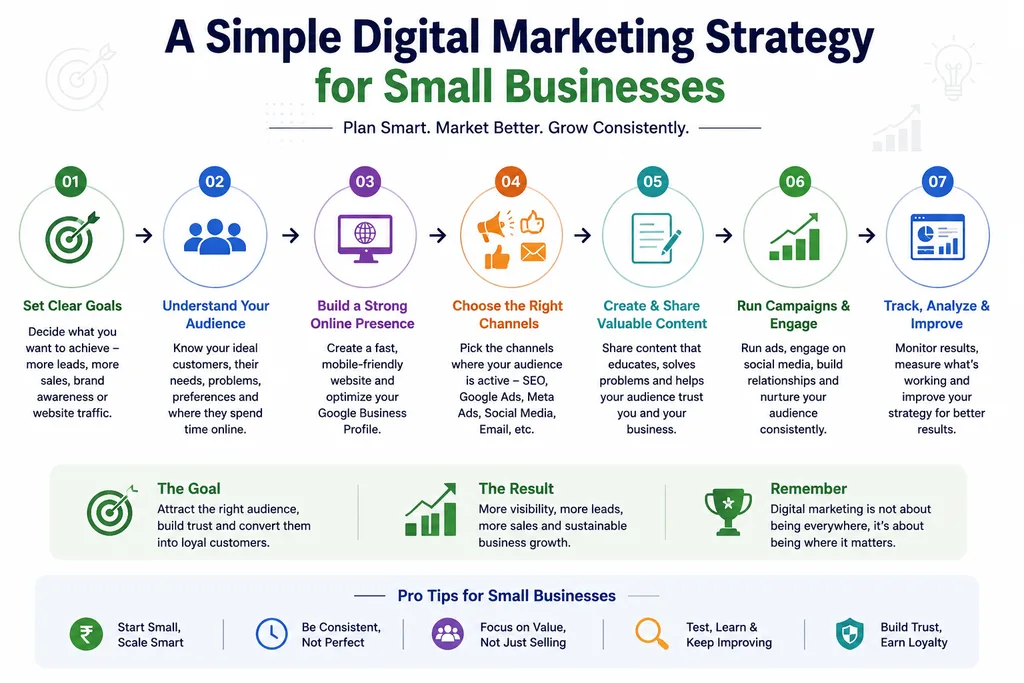
1. Define Your Business Goals
Start by deciding what you actually want from digital marketing.
Do you want more phone calls? Website enquiries? Online sales? Store visits? Brand awareness?
Your goal will influence which channels you should focus on. For example, a local service business may prioritize local SEO and Google Ads, while an e-commerce business may focus more on SEO, Meta Ads, Google Ads, and product-focused content.
2. Understand Your Target Audience
Before spending money on marketing, understand who you are trying to reach.
Think about your ideal customer’s location, needs, problems, buying behaviour, and the questions they ask before purchasing. This helps you create content and advertising that feels relevant instead of trying to reach everyone.
3. Build a Strong Online Foundation
Your website, Google Business Profile, social media profiles, and other important business listings should contain accurate and consistent information.
Your website should clearly explain what you offer, who you serve, why customers should choose you, and how they can contact or buy from you.
If the foundation is weak, even a good advertising campaign can struggle to deliver results.
4. Choose the Right Marketing Channels
You do not need to be everywhere.
Choose channels based on how your customers discover and evaluate businesses. SEO can be valuable for long-term organic visibility, Google Ads can help capture existing search demand, while social media and Meta Ads can help with awareness, engagement, and lead generation.
A small business working with a digital marketing agency (Growtro) can also evaluate these channels based on its budget, industry, competition, and growth goals rather than following a one-size-fits-all strategy.
5. Create Useful Content
Content should answer real questions and help potential customers make better decisions.
Instead of creating content simply because you need to post something, focus on topics your audience actually searches for or discusses. This could be a how-to guide, comparison, FAQ, product explanation, case study, or practical tip.
Useful content can support SEO, social media, paid campaigns, and even visibility in AI-powered search.
6. Track What Is Working
Once your campaigns are running, look at the numbers that matter to your business.
Website traffic alone does not tell the whole story. Track enquiries, qualified leads, purchases, phone calls, conversion rates, cost per lead, advertising spend, and revenue where possible.
This helps you identify which channels are bringing real business results and where your budget may need to be adjusted.
A good digital marketing strategy is not something you create once and leave untouched. Customer behaviour, competition, search trends, and platforms continue to change. Reviewing your results regularly allows you to improve the strategy instead of simply spending more money.
SEO vs Google Ads: Which Is Better for Small Businesses?
One of the first questions many small business owners ask is whether they should invest in SEO or start running Google Ads. The answer depends on what the business needs right now.
SEO focuses on improving your website’s visibility in organic search results. It usually takes time to build rankings, but a well-optimized website can continue attracting relevant traffic without paying for every click.
Google Ads, on the other hand, can help a business appear in search results much faster. You pay when someone clicks on your advertisement, making it useful when you want to generate enquiries, sales, or traffic within a shorter period.
For example, a newly launched local business may use Google Ads to start getting visibility while working on its long-term SEO. As the website gains authority and organic rankings improve, the business can gradually rely more on organic traffic.
This does not mean SEO and Google Ads have to compete with each other. In many cases, using both can create a stronger digital marketing strategy. Google Ads can capture people who are ready to take action, while SEO can help build long-term visibility and trust.
A digital marketing agency (Growtro) can help a small business decide how much focus to put on SEO, paid advertising, or both based on its goals, competition, budget, and customer journey.
The better question is not “SEO or Google Ads?” but rather which approach makes the most sense for your business at its current stage of growth?
How Can Small Businesses Use Social Media Marketing?
Social media has become more than a place to share updates. For small businesses, it can be a way to show what the business is about, build trust, stay connected with customers, and bring attention to products or services.
The key is to use social media with a purpose instead of posting just to stay active.
Choose Platforms That Match Your Audience
You do not need to create an account on every social media platform. Start with the platforms your potential customers actually use.
For example, a local bakery can use Instagram to showcase cakes, customer orders, seasonal products, and short behind-the-scenes videos. A coaching centre may use Instagram and Facebook to share educational content, student achievements, and information about upcoming batches.
A small B2B software company, however, may get better results from LinkedIn, where it can share industry insights, product updates, and case studies with business decision-makers.
The right platform depends on where your customers spend their time, not simply on which platform is currently popular.
Focus on Useful and Relevant Content
People are more likely to engage with content that gives them something useful or interesting.
A local gym, for example, could share simple workout tips, common fitness mistakes, trainer advice, and member success stories instead of posting only promotional offers.
Similarly, a home interior business could share before-and-after projects, space-saving ideas, material comparisons, and short explanations of how different designs work for different types of homes.
This type of content gives potential customers a reason to follow the business even when they are not ready to buy immediately.
Use Social Media to Build Trust
A potential customer may discover your business through Google but check your social media before contacting you. Regular activity, genuine customer reviews, examples of your work, and clear information about your products or services can help reduce that uncertainty.
For example, someone looking for a photographer for a wedding may check their Instagram portfolio before making an enquiry. Seeing real projects, client feedback, behind-the-scenes moments, and consistent work can give the customer more confidence than a simple advertisement.
Social media should therefore support the wider customer journey rather than work as a completely separate marketing channel.
Combine Organic Content With Paid Advertising
Organic posts help businesses build a connection with their existing audience, while paid campaigns can help reach a larger or more specific group of potential customers.
For example, a local clothing boutique could post a new collection on Instagram and see which products receive the most interest. The business could then use Meta Ads to promote those products to people in its target location and age group.
A real estate consultant could also use short property videos to attract organic attention and then run lead-generation ads to people interested in buying property in a specific area.
This approach allows small businesses to combine useful content with targeted advertising instead of depending entirely on one method.
The goal of social media marketing for small businesses should not simply be to collect followers. A smaller but relevant audience that engages with your business and eventually becomes customers can be far more valuable than a large audience with little connection to what you sell.
How Is AI Changing Digital Marketing for Small Businesses in 2026?
The way people search for information is changing. Instead of typing a few short words into Google, people are increasingly asking complete questions and using AI-powered tools to find information, compare options, and discover businesses.
For a small business, this creates a new opportunity, but it also changes what good online content looks like.
Search Is Becoming More Conversational
A customer may no longer search only for “best digital marketing agency.” They might ask an AI tool something more specific, such as, “Which digital marketing agency can help a small business generate leads with a limited budget?”
This means your website needs to clearly explain what you do, who you help, what problems you solve, and why your business is worth considering.
Useful Content Matters More Than Keyword Repetition
In traditional SEO, keywords are important, but simply repeating the same keyword throughout a page is not a strong strategy.
A better approach is to answer real customer questions in clear language. For example, a local accounting firm could publish content explaining how GST registration works for a small business, what documents are required, and common mistakes business owners make.
That content can help the business attract people searching for answers while also demonstrating knowledge and experience in its field.
GEO and AEO Are Becoming Part of the Conversation
SEO focuses primarily on helping content perform well in search engines. Answer Engine Optimization (AEO) focuses on making information easy for answer-based systems to understand and use, while Generative Engine Optimization (GEO) looks at visibility across generative AI search experiences.
For small businesses, this does not mean creating a completely separate type of website. The fundamentals are still important: clear information, useful content, accurate business details, good website structure, and genuine expertise.
For example, a local dental clinic can create clear pages answering questions about dental treatments, costs, preparation, aftercare, and common concerns. This gives both potential customers and search systems more useful information about the clinic’s expertise and services.
Your Website Still Matters
With the growth of AI search, some businesses may think having a website is becoming less important. In reality, your website can become even more valuable because it is the place where you control the most detailed information about your business.
A well-structured website should clearly communicate your services, locations, experience, customer reviews, contact information, and useful resources.
A small digital marketing agency (Growtro), for example, can use service pages, case studies, FAQs, and educational blogs to explain its expertise and help potential clients understand what services may be suitable for their business.
AI is changing how people discover information, but the basic principle remains the same: businesses that provide clear, useful, and trustworthy information have a better chance of being discovered and considered.
What Are the Common Digital Marketing Mistakes Small Businesses Make?
Digital marketing can work well for a small business, but only when it is approached with the right expectations. Many businesses spend money on marketing without having a clear plan, which can lead to wasted time, inconsistent results, and unnecessary expenses.
Here are some common mistakes worth avoiding.
Trying to Be Everywhere
Being active on every social media platform may sound like a good idea, but it can quickly become difficult to manage.
For example, a local restaurant may get better results by consistently using Instagram, Google Business Profile, and local SEO instead of trying to maintain active accounts on five or six different platforms.
Start with the channels that are most relevant to your customers and expand only when you have the time and resources to manage them properly.
Focusing Only on Followers and Likes
A large follower count does not necessarily mean a business is growing.
A local salon with 2,000 relevant followers who regularly enquire about services can potentially get more business than a page with 20,000 followers from locations where the salon does not operate.
Look beyond likes and followers. Track enquiries, bookings, leads, sales, website actions, and other metrics that connect marketing activity to actual business results.
Running Ads Without a Clear Goal
Launching an advertisement and hoping people will buy is not a strategy.
Before running Google Ads or Meta Ads, decide what the campaign is supposed to achieve. It could be generating calls, collecting leads, selling a product, getting bookings, or driving qualified traffic to a website.
A home renovation company, for example, may get thousands of ad impressions but very few enquiries if its targeting, offer, landing page, or call-to-action is unclear.
Ignoring the Website Experience
Marketing can bring people to your website, but the website needs to help them take the next step.
If a local plumber runs Google Ads but the landing page takes too long to load, does not clearly mention the service area, or makes it difficult to find the phone number, potential customers may simply leave.
Your website should be fast, mobile-friendly, easy to navigate, and clear about what you want visitors to do.
Expecting Immediate SEO Results
SEO is a long-term marketing activity. A business may not see significant organic traffic immediately after publishing a few pages or blog posts.
Businesses sometimes give up too early because they expect first-page rankings within a few weeks. In reality, results can depend on factors such as competition, website authority, content quality, technical issues, and the search terms being targeted.
A consistent SEO strategy is generally more useful than constantly changing keywords or publishing content without a clear purpose.
Using the Same Strategy as Everyone Else
What works for one business may not work for another.
A local café, an online fashion store, and a B2B consulting company have different audiences, buying journeys, competition, and goals. Their digital marketing strategies should reflect those differences.
A good digital marketing agency (Growtro) should therefore start by understanding the business and its customers before recommending channels, campaigns, or budgets.
If you are unsure where to start, Growtro can help you identify the right digital marketing channels and create a strategy around your business goals, audience, and budget. Instead of investing in every available platform, you can focus your time and budget on the activities most likely to bring meaningful results.
The biggest mistake is treating digital marketing as a checklist. The goal is not to simply complete SEO, post on Instagram, or run ads. The goal is to build a marketing system that consistently connects your business with the right customers.
How Much Does Digital Marketing Cost for a Small Business in 2026?
One of the first questions a small business owner usually has is simple: How much should I spend on digital marketing?
There is no fixed number that works for every business. A local service provider, a small e-commerce store, and a growing B2B company can have very different marketing needs and budgets.
The cost depends on several factors, including the services you need, your industry, competition, target location, business goals, and whether you are investing in organic marketing, paid advertising, or both.
SEO Budget
SEO is generally a long-term investment. A small business may spend on keyword research, website optimization, technical SEO, content creation, local SEO, and link building.
For example, a local electrician targeting one city may need a different SEO budget from an e-commerce store trying to rank for highly competitive product keywords across India.
The important thing is to look at SEO as an investment in long-term visibility rather than expecting immediate results.
Google and Meta Ads Budget
Paid advertising requires two separate considerations: the ad spend and the cost of managing the campaigns.
A small business can start with a controlled advertising budget, test different audiences and creatives, and increase spending when it finds campaigns that generate profitable results.
For example, a local coaching centre might begin with a focused campaign targeting students and parents in specific areas instead of spending a large amount across a broad audience.
Start With What Your Business Can Actually Support
Spending more does not automatically produce better results.
If a business has a limited budget, it is usually better to focus on one or two channels that have a clear connection to its customers rather than spreading the budget across SEO, Google Ads, Meta Ads, multiple social platforms, and other activities at the same time.
A digital marketing agency (Growtro) can help businesses evaluate their goals, competition, current online presence, and available budget before deciding where to invest.
The right budget is one that your business can sustain long enough to collect meaningful data, improve the strategy, and measure actual business outcomes.
Before deciding how much to spend, ask a more useful question: What result do I need from my marketing investment, and what would that result be worth to my business?
How to Measure Digital Marketing Success for Your Small Business
Getting more traffic, followers, or clicks may look good on paper, but these numbers alone do not tell you whether your digital marketing is actually helping your business.
The real question is simple: Is your marketing bringing you closer to your business goals?
For a small business, the metrics you track should depend on what you are trying to achieve.
Website Traffic
Website traffic shows how many people are visiting your website and where they are coming from.
For example, if a local furniture store starts an SEO campaign and organic traffic gradually increases, that is a positive sign. But traffic becomes more meaningful when those visitors also view products, contact the business, request a quote, or visit the store.
Leads and Enquiries
For service-based businesses, leads are often more important than traffic.
A digital marketing agency (Growtro), for example, may track how many visitors fill out a contact form, send a WhatsApp enquiry, request a consultation, or call after visiting the website.
This helps connect marketing activity with actual potential customers.
Conversion Rate
Conversion rate tells you what percentage of visitors take a desired action.
That action could be submitting a form, making a purchase, booking an appointment, or calling the business.
If 1,000 people visit a website and 30 submit an enquiry, the conversion rate is 3%. Improving that percentage can sometimes be more valuable than simply trying to increase traffic.
Cost Per Lead
If you are running paid advertising, keep an eye on how much it costs to generate each lead.
For example, if a local real estate consultant spends ₹20,000 on advertising and receives 100 leads, the average cost per lead is ₹200.
But the lowest cost per lead is not always the best result. If most of those leads are irrelevant, a campaign generating fewer but better-quality enquiries may actually be more valuable.
Return on Investment
Ultimately, businesses need to understand whether their marketing investment is producing enough value.
If you spend ₹50,000 on digital marketing and generate ₹2 lakh in attributable revenue, the campaign deserves a very different evaluation from one that generates only a handful of low-quality enquiries.
The exact way you calculate ROI will depend on your business model and tracking setup, but the principle remains the same: measure business outcomes, not just marketing activity.
The best digital marketing strategy for small businesses is one that is measured, reviewed, and improved over time. When you know which channels are bringing valuable customers, you can make better decisions about where to invest your next marketing rupee.
How to Choose the Right Digital Marketing Agency for Your Small Business?
Choosing a digital marketing agency is an important decision, especially for a small business where every marketing rupee matters. The right agency should not simply promise more traffic, followers, or leads. It should understand your business and explain how its work can contribute to your actual goals.
If you are considering a digital marketing agency (Growtro), look beyond the list of services they offer and pay attention to how they approach your business.
Look at Their Approach
A good agency should first try to understand your business, customers, competitors, and goals.
Be careful if an agency immediately recommends a package without asking what you sell, who your customers are, where you operate, or what you are trying to achieve.
Check Their Services
Your business may need SEO, Google Ads, Meta Ads, social media marketing, content, website optimization, or a combination of several services.
Choose an agency that can recommend the right mix instead of trying to sell you every service available.
For example, a local restaurant may need local SEO, Google Business Profile optimization, social media content, and targeted advertising. An e-commerce business may have very different requirements.
Ask How They Measure Results
A professional agency should be able to explain what it will measure and why those metrics matter.
Instead of accepting vague promises such as “We will increase your online presence,” ask how success will be measured. Depending on your goals, this could include qualified leads, enquiries, sales, conversion rate, organic traffic, cost per lead, or return on advertising spend.
Look for Transparency
You should know what work is being done, where your budget is going, and how progress will be reported.
Clear communication is particularly important when you are working with a digital marketing agency (Growtro) because marketing results often require testing, analysis, and adjustments rather than a one-time setup.
Think Beyond Short-Term Results
A good marketing partner should help you build something sustainable.
Getting a few leads from an advertising campaign is useful, but building organic visibility, improving your website, creating useful content, understanding your audience, and developing a repeatable customer acquisition process can create value over a much longer period.
For small businesses looking for a practical and customized approach, Growtro works as a digital marketing agency focused on helping businesses build their online presence, reach the right audience, and turn digital marketing efforts into measurable business outcomes.
If you are unsure which marketing channels are right for your business, you can start with a consultation with Growtro. Discuss your current online presence, marketing challenges, goals, and budget, and use that conversation to identify the opportunities worth focusing on.
The right agency should not make digital marketing more complicated. It should help you understand what needs to be done, why it matters, and how it can contribute to your business growth.
A Simple Digital Marketing Plan for Small Businesses
You do not need a huge marketing budget or a large team to start building a strong online presence. What you need is a clear direction and a strategy that you can consistently follow.
If you are starting from scratch, do not try to work on every marketing channel at the same time. Start with the areas that can have the biggest impact on your business.
Step 1: Build or Improve Your Website
Make sure your website clearly explains what your business offers, who you serve, where you operate, and how customers can contact you.
Keep the website mobile-friendly, easy to navigate, fast to load, and focused on helping visitors take the next step.
Step 2: Work on Your Search Visibility
Research the terms your potential customers use when looking for your products or services.
Optimize your important website pages around relevant search intent and create useful content that answers customer questions. If you serve a specific location, include local SEO in your strategy as well.
Step 3: Use Paid Advertising Where It Makes Sense
If your business needs faster visibility, consider Google Ads or Meta Ads.
Start with a controlled budget, define a clear campaign goal, and track the leads or sales generated. Do not increase spending simply because an advertisement is receiving clicks.
Step 4: Stay Consistent on Social Media
Choose one or two platforms that make sense for your audience and create content consistently.
Show your products, share useful information, answer common questions, demonstrate your work, and give people a reason to remember your business.
Step 5: Measure and Improve
Review your results regularly. Look at traffic, leads, enquiries, conversions, advertising costs, and revenue rather than focusing only on likes or impressions.
Keep what is working, improve what is underperforming, and remove activities that are not contributing to your goals.
Where Should You Start?
If you are new to digital marketing, use these priorities as a starting point:
1. Get your online foundation right
Make sure your website, Google Business Profile, contact details, and social media profiles are complete and consistent.
2. Choose one primary customer acquisition channel
If customers actively search for your service, start with SEO or Google Ads. If your product or service is highly visual, social media and Meta Ads may be a better starting point.
3. Create content around real customer questions
Find out what potential customers want to know before they buy and create useful pages, blogs, videos, or FAQs around those questions.
4. Set up proper tracking
Before increasing your marketing budget, make sure you can track where enquiries, leads, and sales are coming from.
5. Give the strategy enough time to learn
Do not change everything after a few days. Collect data, understand what is working, make improvements, and then decide where to increase or reduce your investment.
You do not have to complete all of these steps at once. Start with the most important gap in your current online presence and build from there.
If you are not sure which priority should come first, Growtro, a digital marketing agency, can help you assess your current online presence and identify the channels and activities that make the most sense for your business.
Book a consultation with Growtro to discuss your business goals, current marketing efforts, and the next steps for building a practical digital marketing strategy.
Frequently Asked Questions About Digital Marketing for Small Businesses
What is the best digital marketing strategy for a small business?
There is no single strategy that works for every small business. The right approach depends on your target audience, industry, location, competition, and goals. A local business may benefit from local SEO and Google Ads, while an e-commerce business may need SEO, Meta Ads, Google Ads, and content marketing.
How much does digital marketing cost for a small business?
The cost depends on the services you need and the goals you want to achieve. A business may invest in SEO, paid advertising, social media, content, website improvements, or a combination of these. It is better to set a sustainable budget based on expected business outcomes rather than choosing a budget only because it is cheaper.
How long does SEO take for a small business?
SEO usually takes time because rankings depend on factors such as competition, website quality, content, authority, and the keywords being targeted. Some improvements may appear relatively quickly, while meaningful organic growth can take several months. Consistency and regular optimization are important.
Should a small business use Google Ads or Meta Ads?
It depends on how customers discover and make decisions about your product or service. Google Ads can be useful when people are actively searching for what you offer, while Meta Ads can be effective for reaching specific audiences, building awareness, and generating demand.
Many businesses can benefit from using both as part of a broader digital marketing strategy.
Is social media marketing enough for a small business?
Social media can be valuable, but relying only on social media can limit your reach. Your customers may also use Google, maps, websites, reviews, and other platforms when researching a business.
A stronger approach is to use social media alongside the channels that are most relevant to your audience.
Do small businesses need a digital marketing agency?
Not every business needs an agency from day one. However, an experienced digital marketing agency (Growtro) can be useful when a business does not have the time, expertise, or resources to manage SEO, paid advertising, social media, content, and website optimization internally.
The right agency should help you understand what needs to be done and why, rather than simply selling a package of services.
Final Thoughts: Building a Digital Presence That Grows With Your Business
Digital marketing for small businesses is not about doing everything at once. It is about understanding your customers, choosing the right channels, and consistently improving what works.
For one business, that may mean investing in SEO and local search visibility. For another, Google Ads or Meta Ads may bring faster results. Some businesses may need to improve their website first, while others may benefit from stronger content and social media marketing.
What matters most is having a clear strategy behind your marketing efforts.
As search behaviour continues to change in 2026, businesses also need to think beyond traditional search. A useful website, trustworthy information, strong local presence, helpful content, and a consistent digital footprint can help your business stay visible across both search engines and emerging AI-powered search experiences.
You do not need to have everything perfect before getting started. Begin with the biggest gap in your current online presence, focus on the channels that can reach your customers, measure the results, and improve your strategy as you learn.
Ready to Build a Better Digital Marketing Strategy?
If you are a small business owner and are unsure where to start, Growtro, a digital marketing agency, can help you identify the right opportunities for your business.
From SEO and Google Ads to Meta Ads, social media marketing, content, and website optimization, the focus should be on choosing the right strategy for your goals rather than simply using more marketing channels.
Book a consultation with Growtro today to discuss your business, understand where your current digital marketing stands, and create a practical roadmap for reaching the right customers online.
Digital Marketing for Small Businesses: Key Takeaways
If you are a small business owner trying to improve your online presence, you do not need to master every part of digital marketing at once.
Start by understanding what your customers are looking for and where they are most likely to find you. Then focus your efforts on the channels that support your business goals.
Here are the key points to remember:
- Build a strong website: Make it clear, fast, mobile-friendly, and easy for visitors to take action.
- Invest in SEO: Build long-term visibility by targeting relevant search terms and creating genuinely useful content.
- Use paid advertising strategically: Google Ads and Meta Ads can help you reach potential customers faster when campaigns are properly targeted and tracked.
- Use social media with a purpose: Focus on relevant content and meaningful engagement rather than simply chasing followers.
- Do not ignore local SEO: If your business serves a specific area, make it easy for nearby customers to discover and contact you.
- Track real business results: Leads, sales, bookings, enquiries, and revenue are more useful indicators than likes and impressions alone.
- Keep adapting: Search behaviour and digital platforms continue to evolve, so your strategy should be reviewed and improved over time.
Most importantly, digital marketing should support your business rather than become another complicated task on your list.
Ready to Grow Your Business Online?
If you are investing time or money into digital marketing but are not sure whether it is actually moving your business forward, it may be time to take a closer look at your strategy.
Growtro, a digital marketing agency, can help you identify what is working, what needs improvement, and which marketing channels deserve your attention.
Whether you need SEO, Google Ads, Meta Ads, social media marketing, content marketing, or website optimization, the goal is to build a strategy that fits your business instead of following a generic marketing plan.
Book a consultation with Growtro today. Tell us about your business, your current challenges, and where you want to go. We will help you identify the practical digital marketing opportunities you can focus on next.
Your competitors are already building their online presence. Make sure your business is not being left behind.