
Search Engine Optimization (SEO) is the process of improving a website so that search engines can better understand its content and show it to the right people when they search online. It includes everything from website structure and technical performance to content, keywords, user experience and online authority.
For businesses, SEO is not just about appearing higher on Google. It helps potential customers find your business, understand what you offer and build trust before they decide to take action.
Over the years, the way people search has changed, and SEO has changed with it. With AI-powered search, conversational queries and continuously evolving search algorithms, businesses now need a broader approach to building online visibility.
So, what exactly has changed between traditional SEO and the way SEO works in 2026?
That’s where the real difference begins.
What Is SEO and Why Does Your Business Need It?
SEO, or Search Engine Optimization, is the process of improving a website so search engines can understand its content and connect it with people who are actively searching for related information, products or services.
For a business, SEO helps build long-term online visibility. When someone searches for a service your business provides, a well-optimised website has a better opportunity to appear in relevant search results and bring the right audience to your website.
SEO works across several areas, including:
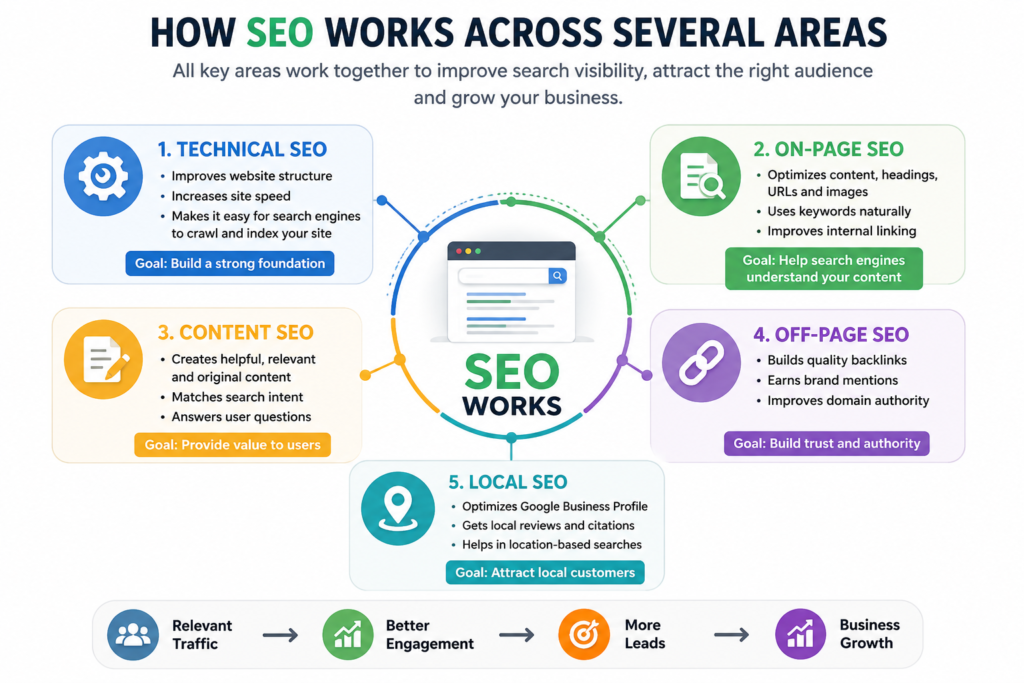
- Technical SEO — improving website structure, speed, crawlability and indexability.
- On-Page SEO — optimising content, headings, keywords, URLs, images and internal links.
- Content SEO — creating useful content that matches what people are actually searching for.
- Off-Page SEO — building relevant authority through backlinks, mentions and other external signals.
- Local SEO — helping businesses become more visible in location-based searches.
The real value of SEO isn’t simply getting more visitors. It’s about attracting relevant traffic from people who are more likely to engage with your business, enquire about your services or become customers.
In simple terms, SEO helps your business get found by the right people at the right time.
How Does SEO Work?
SEO works by improving different parts of a website so search engines can discover, understand, evaluate and rank its pages for relevant searches.
When someone searches for something on Google, the search engine doesn’t simply look for pages containing the exact keyword. It considers factors such as relevance, content quality, website structure, search intent, authority and user experience to determine which results are most useful.
A simple way to understand the SEO process is:
Crawl → Understand → Evaluate → Rank → Discover → Improve
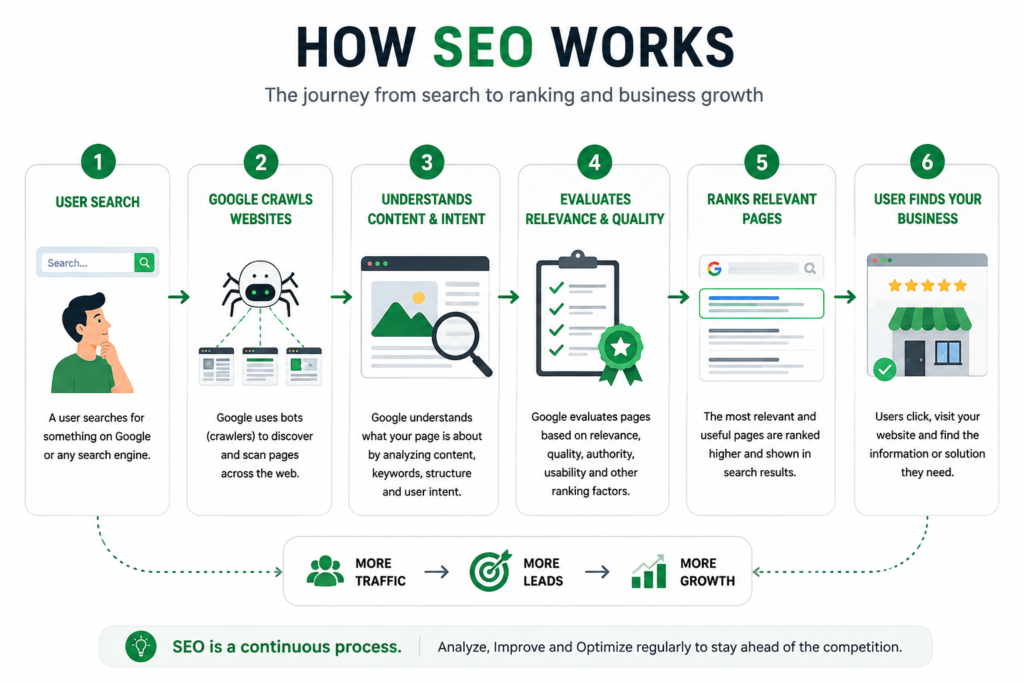
1. Crawl
Search engines use automated bots to discover pages and follow links across your website.
2. Understand
The content, headings, internal links, images and overall structure help search engines understand what each page is about.
3. Evaluate
Search systems assess whether the page is relevant, useful, trustworthy and a good match for the user’s search intent.
4. Rank
When someone searches, search engines select and order the most relevant results for that particular query.
5. Discover & Improve
After publishing, SEO doesn’t stop. Search data, user behaviour and performance help identify what needs to be improved over time.
That’s why SEO is not a single action. Technical SEO, content, on-page optimisation, authority and user experience work together to improve a website’s visibility and bring more relevant visitors to the business.
How Does an SEO Strategy Work?
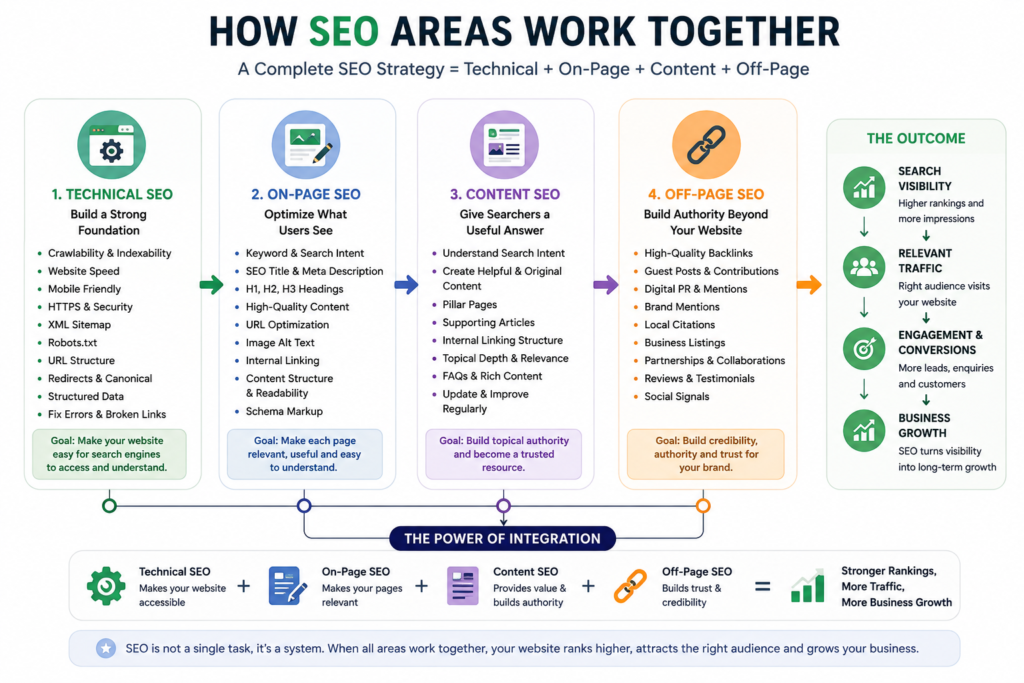
SEO strategy is not about changing one or two things on a website and waiting for rankings to improve. It works by bringing together technical SEO, on-page SEO, content and off-page SEO so that search engines can understand the website, while users get a useful experience.
A practical SEO strategy usually works across these four areas:
1. Technical SEO — Build a Strong Foundation
Technical SEO focuses on making the website easy for search engines to crawl, understand and index.
Important areas include:
- Website speed and Core Web Vitals
- Mobile responsiveness
- HTTPS and website security
- XML sitemap
- Robots.txt
- Crawlability and indexability
- Proper URL structure
- Canonical tags
- Redirects and broken links
- Website architecture
- Internal linking
- Structured data where relevant
- Image optimisation
- JavaScript-related accessibility issues
The goal is simple: make sure search engines can properly access and understand the important pages of your website.
On-Page SEO — Optimise What Users See
On-page SEO focuses on the content and elements present on individual pages.
This can include:
- Keyword and search-intent optimisation
- SEO title and meta description
- H1, H2 and H3 headings
- Page content
- Relevant semantic keywords and related terms
- URL optimisation
- Image alt text
- Internal links
- Descriptive anchor text
- Content structure and readability
- Helpful FAQs where appropriate
- Relevant structured data
For example, if a page targets SEO services for small businesses, simply repeating that phrase throughout the page isn’t enough.
The page should clearly explain the services, answer common customer questions, demonstrate expertise and guide the visitor towards the next useful action.
On-page SEO connects what people search for with what your website actually offers.
3. Content SEO — Give Searchers a Useful Answer
Content is where SEO connects with search intent and topical authority.
Instead of creating articles only because a keyword has search volume, first understand what the audience wants to know.
A strong content strategy can include:
Pillar page → Supporting articles → Internal links → Service/product pages
For example, a digital marketing agency could create a main page about Digital Marketing Services, supported by useful articles about SEO, Google Ads, Meta Ads, social media marketing and content strategy.
The content should add something useful through examples, experience, original insights, data or practical solutions rather than simply rewriting information that already exists elsewhere.
4. Off-Page SEO — Build Authority Beyond Your Website
Off-page SEO focuses on signals and activities that happen outside your own website.
This can include:
- Relevant backlinks
- Digital PR
- Guest contributions
- Industry publications
- Brand mentions
- Local citations
- Business listings where relevant
- Partnerships
- Reviews
- Original research and data that others may reference
The focus should not be on collecting as many backlinks as possible.
A relevant link from a trustworthy website within your industry can be far more valuable than a large number of unrelated or low-quality links.
The broader objective is to build authority, credibility and recognition for your brand.
How These Areas Work Together
Think of SEO as a system rather than four separate tasks:
Technical SEO
↓
Makes the website accessible
On-Page SEO
↓
Makes each page relevant and understandable
Content Strategy
↓
Provides useful answers and builds topical depth
Off-Page SEO
↓
Builds authority and credibility
Search Visibility
↓
Brings relevant users to the website
Conversions
↓
Turns visibility into enquiries, customers and business growth
That’s why a strong SEO strategy in 2026 needs balance. Great content cannot fully compensate for a website that search engines cannot access properly, and technical optimisation alone cannot make thin or irrelevant content valuable.
The real goal is to make the entire website useful — technically, contextually and commercially — for both search engines and the people you want to reach.
What Major SEO Updates Came in 2026?
SEO in 2026 has seen several important changes, especially around AI-powered search, content quality, spam prevention and how website performance is measured. The fundamentals of SEO are still important, but Google has expanded the search experience and introduced new ways for businesses to understand their visibility.
1. AI Overviews & AI Mode Became a Bigger Part of Search
Google has continued expanding generative AI experiences such as AI Overviews and AI Mode. These features can use Google’s search systems to find and combine information from relevant web pages.
For businesses, this means content should be easy to understand, genuinely useful and supported by clear context. Google also confirmed in its 2026 guidance that traditional SEO remains the foundation for appearing in these AI-powered search experiences.
2. Google Added Generative AI Performance Data to Search Console
In June 2026, Google introduced dedicated Search Generative AI performance reports in Search Console for a limited group of websites. These reports provide visibility into impressions generated through features such as AI Overviews and AI Mode.
This is an important shift because SEO measurement is gradually moving beyond traditional blue-link rankings.
3. Google’s 2026 Guidance Put More Focus on Unique Content
Google’s new generative AI SEO guidance specifically highlights the importance of valuable, unique and non-commodity content.
In simple terms, publishing another generic article that says the same thing as hundreds of existing pages is becoming less useful. Content that adds first-hand experience, original insights, useful examples or genuinely new information gives users a stronger reason to visit your website.
4. Core & Spam Updates Continued Throughout 2026
Google rolled out March and May 2026 core updates, along with spam updates in March, June and August. These updates can cause significant changes in search visibility as Google’s systems reassess websites and content.
This makes continuous SEO monitoring more important than relying on a strategy that was successful a few years ago.
5. Some Old SEO Tactics Are Becoming Less Useful
Google also continued tightening its approach to manipulative practices. In 2026, Google clarified that its spam policies apply to generative AI responses as well, while also introducing guidance around practices such as back-button hijacking.
The bigger takeaway is simple:
2026 SEO is moving further toward useful content, genuine expertise, technical accessibility, trustworthy information and sustainable search visibility — rather than shortcuts designed only to manipulate rankings.
SEO: Old Approach vs. 2026 Approach
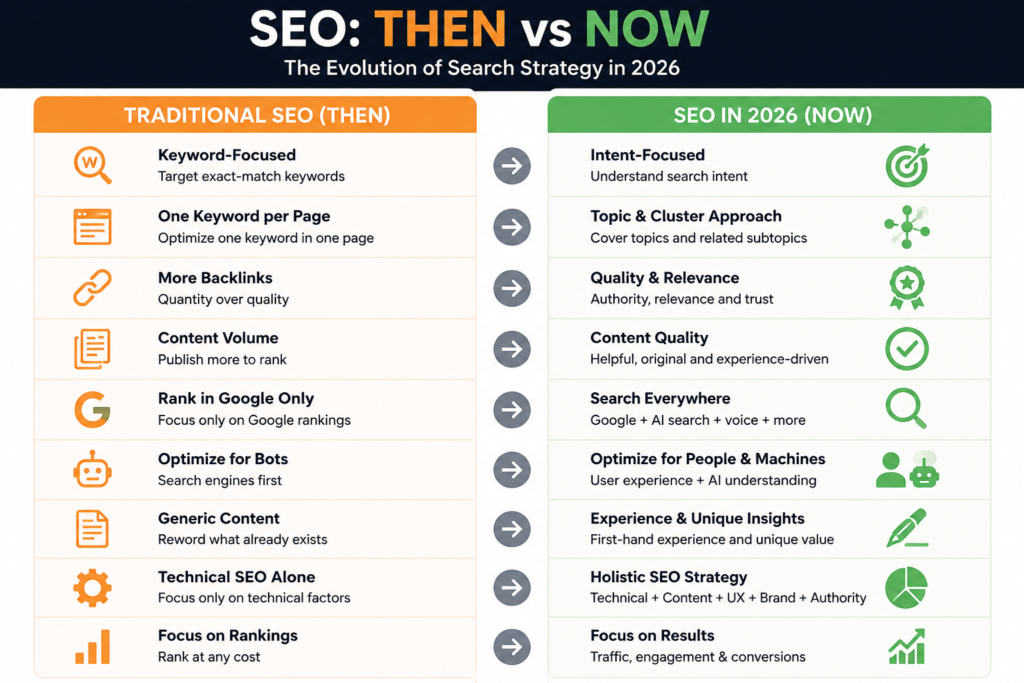
Traditional SEO was largely focused on keywords, rankings and backlinks. Businesses would identify high-volume keywords, optimise individual pages around them, build backlinks and aim to move higher in Google search results. Content was often created around specific keywords, with rankings and organic traffic being the main measures of success.
SEO in 2026 takes a broader approach. Search intent, topical relevance, helpful content, first-hand experience, website quality, brand credibility and user experience now play a much bigger role. Instead of creating separate pages for every keyword variation, businesses can build connected topic clusters that answer the different questions their audience has.
Another major change is the growth of AI-powered search experiences. Businesses can no longer think only about traditional Google rankings. Their content may also be discovered through AI Overviews, AI Mode and other conversational search experiences. This makes clear structure, useful information and strong topical context increasingly important.
The approach to authority has also evolved. SEO is not simply about collecting as many backlinks as possible. Relevant backlinks, brand mentions, digital PR, reviews and genuine industry credibility can contribute to a stronger overall online presence.
Most importantly, the goal of SEO has moved beyond traffic alone. A modern SEO strategy focuses on attracting the right audience, building trust and turning organic visibility into meaningful actions such as enquiries, leads and customers.
In simple terms, old SEO was largely about ranking a page, while SEO in 2026 is about building a website and brand that deserves to be found, trusted and chosen.
SEO has evolved, but its core purpose remains the same: helping the right people find the right business at the right time. The difference is that in 2026, businesses need to look beyond keywords and rankings and focus on relevance, useful content, authority, user experience and the changing ways people discover information online.
The goal is no longer just to rank higher — it’s to build a digital presence that people can find, trust and choose.
Ready to Build a Stronger Digital Presence?
SEO works best when it’s part of a complete digital marketing strategy. At Growtro, we combine SEO, content, performance marketing, social media and web solutions to help businesses build a stronger online presence and a clear digital identity.
If you’re looking to improve your search visibility, attract the right audience and turn online growth into real business results, let’s build a strategy around your goals.
Work with Growtro and let’s grow your business, together.